load_sty() makes a file of your own definitions a package, so that
\usepackage{name} loads it in a label or a document, or
latex_options(packages = "name") loads it before every one.
Value
The name, invisibly. Problems found in the file are given as a warning, with their line and column.
Details
The file is read as LaTeX reads a package: \newcommand, \renewcommand,
\def, \newenvironment, \DeclareMathOperator, \newtheorem and the
like define commands, and @ may be used in a name. Registers (\newcount,
\newdimen, \newskip, \advance, \the, \ifdim) and \catcode work;
boxes are not supported. A file edited after it was loaded is read
again the next time something is drawn.
A package from a TeX distribution can be loaded the same way, from the
file kpsewhich physics.sty finds. physics (under another name than
"physics", which is the bundled one), esdiff, centernot and tensor
(likewise) are known
to run and set their commands as LaTeX does. Packages that use boxes
(\setbox, \hbox to), fonts of their own
(stmaryrd, yhmath, upgreek) or expl3 code (mathtools,
siunitx) do not yet, and say so with a warning.
Examples
sty <- tempfile(fileext = ".sty")
writeLines("\\newcommand{\\RR}{\\mathbb{R}}", sty)
name <- load_sty(sty, "mine")
grid::grid.newpage()
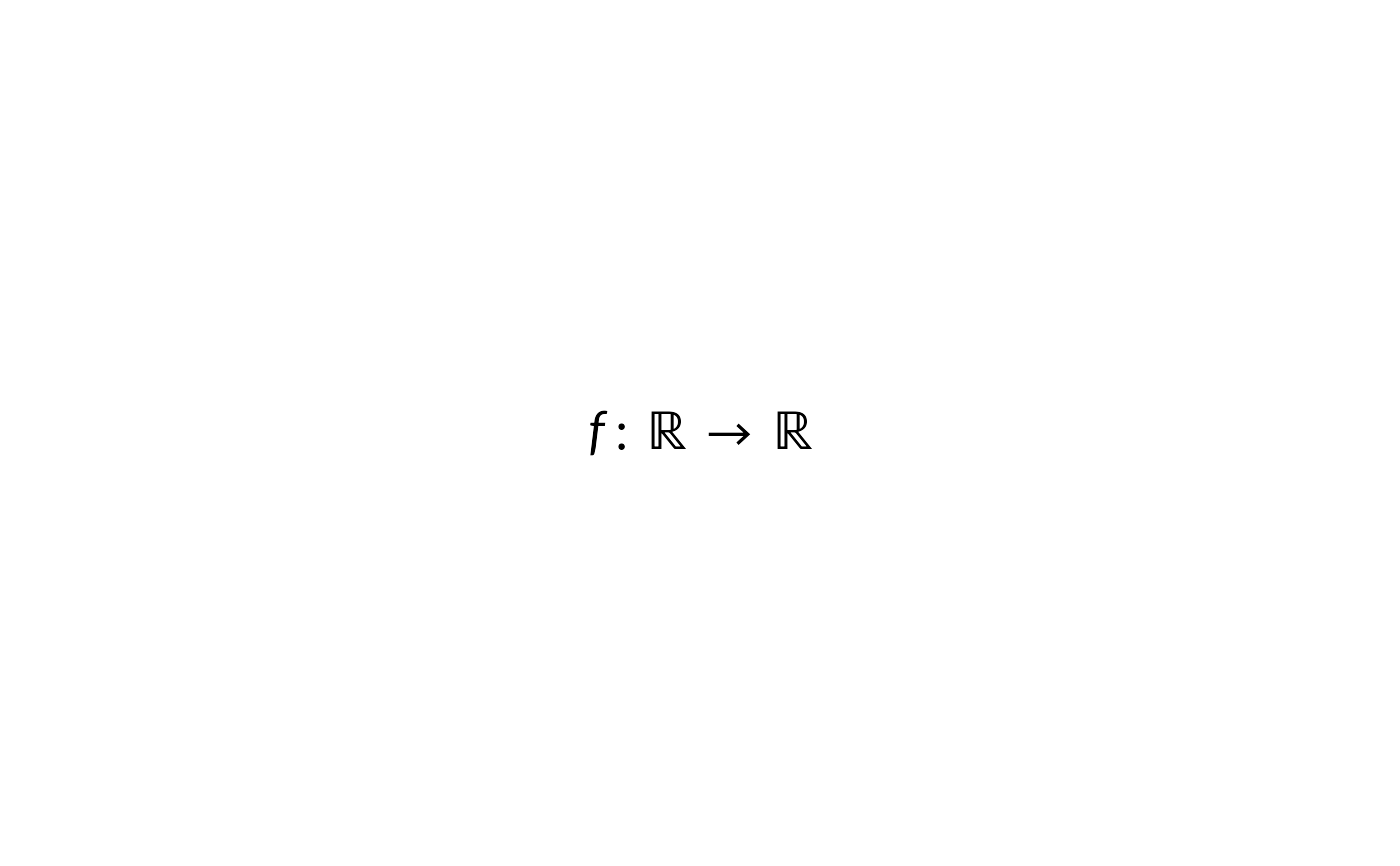
grid.latex("\\usepackage{mine}$f\\colon \\RR \\to \\RR$")